Complete Manarion Guide for Beginners: Every System Explained

Verified against the live game on November 2, 2026 (latest in-game patch notes: October 30, 2026).
Manarion is a free idle RPG that runs in your browser. Your character keeps fighting or gathering on the server while you are offline, so the game fits around your day: you check in a few times, refresh your actions, spend what you earned and make a few decisions. The depth sits in the systems built around that loop: Codex research, guilds, crafted equipment, pets, timed events, jewels and, since October 2026, a constellation skill tree.
This guide is the one page you need for your first weeks. It explains how the game works, which path to pick, why a guild comes first, how gear progresses, what pets and events give you, how Ironman mode differs and what the newer systems do. We checked every number on this page against the game client itself, including its in-game patch notes, so nothing here is carried over from an older version of the game. Dungeons have their own page, the Manarion Dungeon Guide.
Table of Contents
- Getting Started
- How Actions and Quests Work
- Battling vs Gathering: Which Path to Choose
- Codex and Elemental Shards
- Guilds: Join One on Day One
- Equipment: Heirlooms, Mythics and Orbs
- Pets
- Events: Elemental Rift, Rift of Power and Seasonal Events
- Ironman Mode
- Farm, Mage Tower, Dungeons and Jewelcrafting
- Starcharting: The Constellation Skill Tree
- Common Beginner Mistakes
- Useful Commands and Community Tools
- Frequently Asked Questions
- Related Guides
Getting Started
Go to manarion.com and sign in with Google, Discord or Twitch. If you would rather look around first, a guest account works too. You then pick a username, which other players see in chat and on the leaderboards.
The Town page is your main menu. It lists the battle zones, the three gathering zones (Ironclad Mines for Mining, Azure Lake for Fishing and Elderwood Grove for Woodcutting) and everything else: the Farm, the Market, your Guild, the Dungeon, the Mage Tower, Pets and the Gem Shop. Click a zone and your character starts working there until you send it somewhere else.
A good first half hour:
- Pick an activity, either a battle zone or a gathering skill, and let it run.
- Claim your quests as they complete.
- Join a guild. Nothing else on this list matters as much, and the guild section explains why.
- Look in your guild’s armory for Heirloom gear, or plan to craft your own Heirlooms once you find Legendary items (the equipment section shows how).
You do not choose between Standard and Ironman mode at sign-up. Every account starts with a normal (Standard) character, and you can add an Ironman character later from Settings, under Account. The Ironman section covers what changes.
How Actions and Quests Work
Everything in Manarion runs on actions. On every tick your character performs one action, such as casting a spell at an enemy, swinging an axe or casting a fishing line, and this carries on while your browser is closed. Your action pool has a maximum. When it runs low you press refresh to fill it again, so the basic rhythm of the game is checking in before the pool runs dry.
Several things raise your maximum actions:
| Source | What it adds |
|---|---|
| Guild Sleeping Quarters | +1% maximum actions per building level |
| Actions Codex boost | +5 maximum actions per Codex, with no level cap |
| QoL subscription | Triples your base action amount |
| Equipment and buffs | Some gear and buffs add actions |
Quests run in the background. Every action counts toward your current quest, and when it finishes you claim the reward and the next one starts. Quests are your steady source of Codex, the currency behind your permanent upgrades. At first they pay Bound Codex, which only you can spend on your own research. Once you have invested 10,000 Codex in your own research, quests start paying normal Codex that you can trade. After 1,000 quest completions each quest also has a chance to give an extra Codex, and at 2,000 completions that extra Codex is guaranteed.
The QoL subscription
Quality of Life (QoL) is the game’s only subscription. It costs 5 Crystallized Mana a month, and you can buy Crystallized Mana from other players with Mana Dust or from the premium shop. It gives you:
- Triple base action amount
- Automatic joining of events
- Use of your guild members’ enchanting skills
- Automatic farm collection
- Double dungeon queue size
- Automated equipment set switching
QoL is convenience rather than raw power, and plenty of players progress well without it. Since October 17, 2026, Ironman characters get QoL for free.
Battling vs Gathering: Which Path to Choose
Your first real decision is whether to battle or gather. You can switch at any time, but each path has its own equipment, so switching means building a second set of gear. Both paths are equally idle, and neither asks more of your time than the other.
Battling
Battlers fight elemental enemies. You start in Radiant Grove (the beginner zone), move on to The Smoldering Marsh (intermediate) and then settle into one of three elemental zones:
| Zone | Element |
|---|---|
| Worldshaper’s Domain | Nature |
| Blazing Core | Fire |
| Maelstrom’s Eye | Water |
Your spells use one of three elements, each with its own Mastery, and the elements counter each other: Nature beats Water, Water beats Fire and Fire beats Nature. Fight in the zone of the element yours beats, so a Nature mage fights in Maelstrom’s Eye. A staff that matches your spell’s element adds another 10% damage.
Battling earns battle experience, Mana Dust (the main currency), Elemental Shards, equipment, tomes for your spell ranks, enchanting formulas and materials, orbs, and Elementium for Mythic crafting. Battlers also raise their guild’s level through the battle experience tax.
Pick battling if you enjoy tuning a build, watching your damage climb against tougher enemies and chasing the damage and highest-enemy leaderboards.
Gathering
Gatherers, often called trade skillers or TS, level Mining, Fishing or Woodcutting. Each skill is tied to an element: Mining is Fire, Fishing is Water and Woodcutting is Nature. The skills work the same way. What differs is the resource (Iron, Fish or Wood), the tome they drop (Tome of Fire, Water or Nature) and their enchanting materials. Gatherers never fight, so the elemental counters that matter to battlers do not apply to them. Like battlers, gatherers also find Elemental Shards, equipment, formulas and orbs.
Iron, Fish and Wood pay for most guild buildings, the Farm and the Mage Tower, so a guild always needs gatherers. With no combat to tune, gathering is also the more relaxed path.
Pick gathering if you want a calmer loop, like being the one who supplies your guild, and want to level pets quickly (the pets section explains why gatherers have the edge there).
Gathering Nodes (both paths)
Since October 17, 2026, every character can stumble on a Gathering Node, battlers included. Each tick has a 1 in 2,400 base chance to find one. A node runs alongside your normal actions for 100 ticks and harvests a resource on its own. If you find a second node while the first is still running, its timer resets and its rarity goes up one tier. A Common node has a base yield of 1 per tick and a Mythic node a base yield of 6.
The resource depends on the element of the zone you are in:
| Element | Node | Resource |
|---|---|---|
| Fire (Mining, Blazing Core) | Quartz Vein | Quartz |
| Water (Fishing, Maelstrom’s Eye) | Cuttlefish Shoal | Ink |
| Nature (Woodcutting, Worldshaper’s Domain) | Pine Grove | Resin |
Battlers get the resource of the zone they fight in, which is the element their spells beat. A Nature mage fighting in Maelstrom’s Eye finds Cuttlefish Shoals and collects Ink, and the game tells you with a message such as “You’ve harvested a total of 489.64k Ink Sac from an Uncommon Cuttlefish Shoal (12 ticks remaining)”. Ink Sac was renamed Ink on October 27, 2026.
Your normal boosts do not affect nodes. They have their own upgrades instead: the Wayfinder Codex boost, the Moonstone jewel and the Prospecting pet all raise your chance to find one, gathering research spent with Iron, Fish or Wood raises their yield, and several constellation stars improve their rate, duration and yield. Quartz, Ink and Resin pay for Starcharting research (see Starcharting).
How to choose your element or skill
All three elements and all three gathering skills are balanced in power, so let the market decide. Check what each element’s tomes and enchanting materials sell for and lean toward the one whose drops are worth the most. Ask your guild as well: a guild full of Fire battlers will value a Mining gatherer who brings in Tomes of Fire.
Codex and Elemental Shards
Codex research
Codex buys permanent boosts for your character. Each level costs as many Codex as the level you are buying, so level 71 costs 71 Codex. The Codex panel has ten boosts, and nine of them stop at level 100, which makes a maxed boost a total of 5,050 Codex:
| Codex boost | What it does | Level cap |
|---|---|---|
| Base Experience | More experience from every action | 100 |
| Base Resource | More resources per gathering action | 100 |
| Base Mana Dust | More Mana Dust from enemies | 100 |
| Drop Boost | Better chance at nearly every drop | 100 |
| Multistat | More stat drops and mastery gains | 100 |
| Construction | Faster Mage Tower builds | 100 |
| Jewelcrafting | Raises your Jewelcrafting skill | 100 |
| Expedition Rarity | Better rewards from pet expeditions | 100 |
| Wayfinder | Raises your Starcharting rate and your chance to find Gathering Nodes | 100 |
| Actions | +5 maximum actions for every Codex spent | None |
Actions is the exception in price as well as cap: every level costs a flat 1 Codex, however many you already own. Our Manarion Codex Chart lists the cost and bonus of every level, with a quick cost calculator.
How to spend your Codex
There is no single right order any more. The four newest boosts (Construction, Jewelcrafting, Expedition Rarity and Wayfinder) each feed a different system, so the best choice depends on what you want to speed up. Some common approaches:
- Level faster: Base Experience speeds up everything you do, which is why many players start there.
- Earn more: Base Mana Dust for battlers or Base Resource for gatherers grows your income, and Drop Boost and Multistat grow your drops and stats over time.
- Build up the side systems: Construction shortens every Mage Tower build, Jewelcrafting lets you work with better jewels, and Expedition Rarity shifts pet expeditions toward rarer rewards. At 100% Expedition Rarity the odds move from 60%, 25%, 10%, 3.5%, 1.2% and 0.3% across the six tiers to 20%, 50%, 20%, 7%, 2.4% and 0.6%.
- Push Starcharting: Wayfinder raises your Starcharting rate and helps you find Gathering Nodes, which pay for more Starcharting research.
- More actions: Actions is cheap per level and never caps, but your guild’s Sleeping Quarters and QoL also raise your pool, so most players do not need it early.
Whatever you choose, spend Bound Codex as you get it. It cannot be traded, so holding it gains you nothing. Codex boosts can be reset if you change your mind, at a cost based on what you invested in the boosts other than Actions.
Elemental Shards
Elemental Shards fund your second research tree, with boosts for combat stats (Damage, Health, Crit Chance, Crit Damage, Multicast, Haste and more) and for each gathering skill. Your guild’s Nexus Crystal amplifies every shard boost, which is a big reason a strong guild matters.
Battlers usually start by spreading shards across Damage, Health, Crit Chance, Crit Damage and Multicast. If you run out of mana, add Mana and Spirit. If your guild’s Mana Conduit is high and you never run dry, lean into Multicast, Haste and Overload. Gatherers can keep it simple and put their shards into their main skill.
You can reset shard boosts for 10% of what you spent. The reset covers your battling and gathering boosts together and refunds you in Bound Elemental Shards.
Guilds: Join One on Day One
A guild is the biggest single boost in Manarion, and it costs you nothing but a small share of what you earn. Every member gets the full effect of every guild building, so a brand new player in a strong guild levels far faster than anyone playing alone.
How guilds work
Guilds run on taxes that the leader sets for each rank. A share of what members earn goes to the guild: battle experience (which raises the guild level), Mana Dust, Iron, Fish and Wood, and Elemental Shards. You keep the rest. The guild spends the pooled funds on buildings, and each guild level adds a resource bonus, more Codex and a new guild dungeon.
The guild buildings
| Building | Effect per level |
|---|---|
| Study Room | +1% base experience |
| Nexus Crystal | Amplifies all Elemental Shard research boosts by 1% |
| Mana Conduit | Reduces the mana cost of all spells by 4% |
| Sleeping Quarters | +1% maximum actions |
| Magical Accounting | +1% resources contributed through guild taxes (the guild receives more, members do not pay more) |
| Council Chamber | +1 maximum guild member |
| Cloakroom | +50 armory slots |
| Ethereal Refinery | Lowers the Resource, Elemental Shard and Codex cost of the other buildings |
| Dungeon Difficulty | Merges several guild dungeons into one, combining their health and rewards |
| Astral Archive | +0.1% Starcharting rate for every member |
The Mana Conduit reduction stacks on itself rather than adding up in a straight line, so it gets close to 100% at high levels without ever reaching it. That is why battlers in strong guilds can ignore mana stats.
The armory and Heirlooms
The armory is the guild’s shared gear pool. Members donate equipment there, and anyone in the guild can borrow it. For new players it is often where Heirlooms come from: gear with no level requirement that you can wear from level 1 (see the equipment section). Borrowed items stay bound to the guild and return to the armory if you leave.
Guild dungeons
Every guild level unlocks a guild dungeon. Members clear its objectives together: Elemental Knights that battlers damage, and Iron, Fish and Wood nodes that gatherers work through. Clearing them pays the guild Codex and other resources, and the loot goes into the guild funds straight away. Once the last unlocked guild dungeon is clear, a final objective can be hit endlessly for a chance at an Orb of Perfection.
Finding a guild
Ask in the Manarion Discord or in global chat. Guilds can open themselves to applications or let anyone join, and guild upgrades are public by default, so you can compare guilds before you apply. As a new player, look for:
- Members who play every day
- High Study Room, Nexus Crystal and (for battlers) Mana Conduit levels
- An armory with gear for your path
- People who answer questions
Do not hold out for the perfect guild. Join an active one now and move on later if you outgrow it. Your taxes stay with the old guild when you leave, but they paid for bonuses you enjoyed while you were there.
Founding your own guild costs 1,000 Iron, 1,000 Fish and 1,000 Wood. On a Standard character it rarely makes sense early, because an established guild is far ahead of anything you can build alone.
Equipment: Heirlooms, Mythics and Orbs
Gear in Manarion does not progress the way it does in most RPGs. The usual path for a Standard player is to wear Heirlooms early, borrowed from the guild or crafted yourself, and then craft your own Mythic gear once you reach level 3,000 and have the materials.
Slots and rarities
You wear a staff (battlers) or a tool (gatherers), armor pieces and jewelry, plus one Sigil from the event system. Battle gear rolls combat stats such as Intellect, Stamina, Focus, Spirit, Mana, Damage, Multicast, Crit, Haste, Overload and Time Dilation, and staffs carry an elemental Mastery. Gathering gear rolls your gathering skill, Intellect, Base Resource Amount and drop-related stats.
Drops come in rising rarities up to Legendary. Above that sit two crafted tiers:
- Heirloom: made by using an Orb of Legacy on a Legendary. It has half the level (and power) of the original but no level requirement, so a level 1 character can wear it.
- Mythic: made from a level 3,000 or higher Legendary. It costs Elementium equal to the item’s level and 1 Divine Essence per 100 item levels. A Mythic battle item gains an extra combat stat, a Mythic gathering item doubles its main skill boost, and all other stats rise by about 8%.
Divine Essence comes from disenchanting level 3,000 or higher Legendary items (10 each). Elementium drops while battling and scales with enemy strength. Disenchanting a Mythic returns half the Elementium and Divine Essence used to make it.
What this means for a beginner
- Borrow or craft Heirlooms early on. A high-level Heirloom beats anything you will find on your own for a long time. Check the armory first, and when a good Legendary drops, an Orb of Legacy turns it into an Heirloom you own. Veteran players are often happy to help new ones, but being able to gear yourself is worth more in the long run.
- Treat Epic and Legendary drops as crafting material. Sell or disenchant the ones you cannot use. Before level 3,000 they are often worth more to crafters than to you, unless you are turning one into an Heirloom.
- Save for Mythics. Keep your Elementium and any Divine Essence for your first Mythic, and start with your staff or tool.
- Use the Equipment Market. You can filter by slot, rarity, level, quality and stats, and a finished item sometimes costs less than crafting it.
The orbs
| Orb | What it does |
|---|---|
| Orb of Power | Rerolls an item’s stat values and keeps any improvement. You can use 10, 100 or 1,000 at once, and unused orbs are refunded once the item hits maximum quality |
| Orb of Chaos | Rerolls which stats an item has, keeping its quality. You can lock stats, and each lock doubles the orbs needed. It can also transmute uncut gems |
| Orb of Divinity | Upgrades an Epic to Legendary, keeping its stats and quality |
| Orb of Legacy | Turns a Legendary into an Heirloom. Extra Orbs of Legacy on an Heirloom add a bonus experience multiplier that shrinks as you approach the Heirloom’s level |
| Orb of Perfection | The rarest orb, found mainly in guild dungeons. It perfects an item and adds a special prefix effect, which you can reroll with Elementium at a cost that doubles each time |
Early on, most orbs are worth more as trade goods than as upgrades on gear you will soon replace. Sell them, or save them for Heirlooms and your first Mythic. The free Rift of Power event (see events) upgrades your equipped gear without costing you any orbs.
Quality, infusion and enchanting
Each stat line shows its quality as a percentage of the maximum roll, and you can hover over it to see that maximum. Infusion spends Mana Dust to raise an item’s power by 5% per infusion level, with costs that climb steeply, so save heavy infusion for gear you will keep for a long time.
Enchanting adds an extra stat line using a formula (a recipe you learn) and enchanting materials. The enchants are Inferno, Tidal Wrath and Wildheart (elemental damage), Fire, Water and Nature Resistance, Insight, Bountiful Harvest, Prosperity, Fortune, Growth and Vitality. Formulas get expensive to learn, so most guilds have one or two dedicated enchanters. If yours does, sending them the formulas you find is good manners and helps the whole guild. If your guild has no enchanter, or nobody needs that formula, selling it is fine. With QoL you can use your guild members’ enchanting skills directly.
Pets
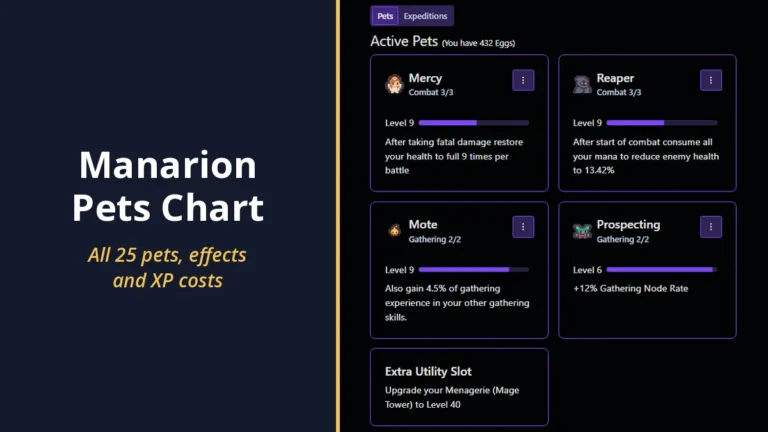
Pets give permanent bonuses and level up as you play. Eggs buy pets, and your first Egg comes from the Elemental Rift event. Each new pet costs more eggs than the last. Eggs can also be traded and used to reroll pet expeditions. For every pet’s exact effect by level, the XP cost of each level and what top players run, see the Manarion Pets Chart.
Pet slots
| Slot type | Slots | Notes |
|---|---|---|
| Combat | 3 | Help while battling |
| Gathering | 2 | Help while gathering |
| Utility | 1, or 2 with Menagerie level 40 | Help in every activity |
All active pets gain experience, but combat and gathering pets gain less while you are doing the other activity. Every level a pet gains also adds bonus experience for your other pets, so pet leveling snowballs.
All 25 pets
| Pet | Effect at level 1 |
|---|---|
| Resurrect | Restores your health to full after fatal damage, once per battle per level |
| Resistance | Raises resistance against all elements |
| Immunity | Before fatal damage, nullifies the next 5 enemy attacks per level |
| Damage | +20% damage, multiplicative per level |
| Curse | At the start of combat, uses all your mana to cut enemy health |
| Poison | After enemy attacks, deals a share of their current health as poison damage |
| Focus | +20% focus, multiplicative per level |
| Ward | +20% ward, multiplicative per level |
| Haste | +20% haste, multiplicative per level |
| Regeneration | Restores health and mana after enemy attacks, fading over long fights |
| Mana Dust | +1% Base Mana Dust per level |
| Egg Drop | 0.01% chance per level to find eggs from normal actions |
| Colony | +6% Magical Accounting per level |
| Mining, Fishing, Woodcutting | +2% base experience per level in that skill |
| Pet bonus xp | +5% pet bonus experience to your other active pets per level |
| Multistat | +5% Multistat per level |
| Dungeon Idle | +10% chance per tick per level of extra idle dungeon progress |
| Versatility | Shares 0.5% per level of your gathering experience with your other gathering skills |
| Foraging | 0.1% chance per level to find a random resource drop |
| Drop | +1% Drop Boost per level |
| Group Dungeon | +3% Gem Tokens per level (Gem Tokens come from group dungeon objectives) |
| Construction | 2% chance per tick per level to cut an extra 3 seconds off Mage Tower builds |
| Prospecting | +2% Gathering Node rate per level |
Which pets first
Buy Egg Drop first. It finds eggs while you play, which speeds up every pet after it. Then pick your path’s core pets. Battlers usually build around Haste plus Curse or Ward, with Resurrect or Immunity for survival. Gatherers take their main skill pet and Versatility, which levels the other two gathering skills on the side. Prospecting is a good later pick for either path if you are investing in Starcharting.
Gatherers level pets faster overall, because combat pets do nothing while gathering. A gatherer can rotate low-level combat pets through those three slots without losing anything, while a battler has to keep their best combat pets equipped.
Pet expeditions
Idle pets can go on expeditions to find loot. You send up to three pets on each one. Every pet has a biome it is at home in (Plains, Forest, Mountain, Cave, Swamp or Ghostlands) and two traits (Offensive, Defensive, Agile, Harvest, Scavenge, Luck, Wisdom or Endurance), and a team that matches the expedition’s location succeeds more often. Locations range from the Enchanted Valley, Ironbound Cliffs and Lake Eerie to the gem locations and the Hidden Roost. Pets still gain experience while they are away. You can buy extra expedition slots with Codex, and the Expedition Rarity Codex boost improves the rewards you are offered. The October 27, 2026 patch raised the maximum number of expedition slots by three and made Tome rewards from expeditions scale with your Drop Boost.
Events: Elemental Rift, Rift of Power and Seasonal Events
Events are free progression, so try not to miss them. Turn on their notifications in Settings, or let QoL join them for you.
Elemental Rift
Elemental Rift opens every 3.5 hours, with a 5-minute queue and 10 minutes of event time. Battlers fight bosses and gatherers harvest. Your result earns Event Points, which since September 2026 depend mostly on your placement rather than your raw output, and this is the event that hands out pet Eggs. Standard and Ironman characters play in separate instances. Your normal potions pause during events, and pets have no effect inside them.
Event Points level up your Sigils automatically. You wear one Sigil at a time and can swap freely:
| Sigil | What it is for |
|---|---|
| Sigil of Distillation | Longer potion duration |
| Sigil of Growth | Stat drops |
| Sigil of Vitality | A general power boost, popular with newer players |
| Sigil of Purpose | Faster quests |
| Sigil of Guidance | Extra Observatory levels for Starcharting (new in October 2026) |
Rift of Power
Rift of Power opens at random every 3 to 6 hours and stays open for 10 minutes. While you siphon it, each action has a chance to apply an Orb of Power to all your equipped items at once. The chance starts at 100% in each rift and falls the more you siphon, down to a floor of 20%. Only equipped items are upgraded, so wear the gear you plan to keep before it opens.
Seasonal events
Manarion runs themed dungeon events through the year, usually with boosted drops, pet skins and titles. The Halloween event runs from October 23 to November 8, 2026: clear event dungeons with other players for increased stat drops and a Wayfinder buff, earn last year’s rewards if you missed them, and unlock two new titles, Haunted and Restless.
Ironman Mode
Ironman is a self-sufficient way to play, added in November 2025. You create an Ironman character under Settings, Account, and switch between it and your normal character whenever you like (Alt+1 and Alt+2 also switch). Each character has its own progress, leaderboards and events.
The rules
- No player trading. You cannot use the player market or trade with others. The NPC Merchant is your only trader, and he swaps resources and tomes at a 5:4 ratio (80%). On a Standard character every unlocked title improves the Merchant rate, but Ironman characters get no Merchant upgrades. The only exception we have found is a star in the constellation: Capricorn adds +1% Merchant Conversion Rate.
- No premium shop. Crystallized Mana can still be wired from another account for name changes and skins.
- Solo guilds only. You found a guild with yourself as the only member, pay for every building alone and clear guild dungeons alone.
- Separate Elemental Rift instance and leaderboards.
- No referral rewards.
- Free QoL. Since October 17, 2026, QoL costs nothing on Ironman characters.
How Ironman changes your plan
You need both paths. Guild dungeons have Elemental Knights (battle level and Mastery) and Iron, Fish and Wood nodes (gathering levels), and your solo guild needs all three resources. A common start is to battle first for shards and early levels, then build up one main gathering skill and use the Merchant for the other two resources rather than leveling all three at once. With the rate fixed at 80%, every trade loses a fifth of what you put in, so trade only what you cannot gather efficiently yourself.
Heirlooms matter less, because nobody can lend you gear and an Heirloom is a halved Legendary. Wear the best Epic and Legendary items you find, and plan your first Mythics around your own drops. Every Elementium and Divine Essence counts, so disenchant spare level 3,000 or higher Legendaries rather than throwing them away.
For guild buildings, put your first resources into Study Room and Nexus Crystal. Magical Accounting pays off once you tax yourself to push buildings. Our free Manarion Dungeon Time Calculator estimates how long a solo guild dungeon takes at your levels.
Our advice: start on a normal character. Learn the systems with a guild behind you, then create an Ironman character once you know what you want from it.
Farm, Mage Tower, Dungeons and Jewelcrafting
None of these is urgent in your first days, but they all compound, so it helps to know what is coming.
The Farm grows Sageroot and Bloomwell, the herbs for your potions. The new Potion of Guidance for Starcharting is made with Sunpetal. You pay Mana Dust upkeep when you collect, and the Hedge Fund upgrade lowers that upkeep. Potions boost experience, shards and more for a set time, and the Sigil of Distillation and the Laboratory make them last longer.
The Mage Tower holds permanent upgrades that take real time to build, one day each by default, and you can speed a build up by spending more resources. Its buildings are the Workshop (faster builds), Planning Office (longer build queue), Spire (boosts shard-based stats on equipment), Library, Training Grounds, Meditation Sanctum, Leyline Tap and Moonwell (base stats), Expedition Hall (more damage in guild dungeons), Menagerie (pet bonus experience, plus a second utility pet slot at level 40), Laboratory (potion duration), Dust Collector (+0.2% Mana Dust per level), Jeweler’s Bench and the Observatory for Starcharting. The Workshop is a sensible first build because it speeds up everything after it.
Dungeons are maps you clear for Elemental Shards, Dungeon Points and treasure. You can run them yourself or let them run idle, and Dungeon Points buy upgrades such as Idle Progress Speed, Treasure, Swiftness, Perception and Auto Loot. How many dungeons you can open depends on your highest level. Our Manarion Dungeon Guide covers the modes, point allocation and skips.
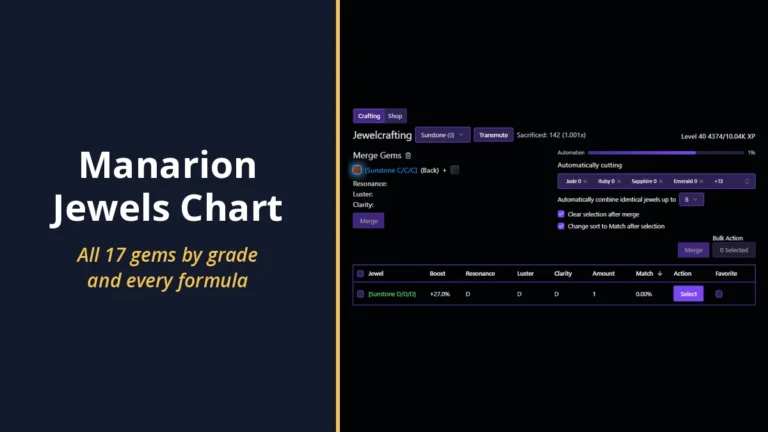
Jewelcrafting runs alongside your normal actions. You cut uncut gems into jewels and merge jewels to improve them. Every jewel is graded F to S in three aspects, Resonance, Luster and Clarity, and you can equip one jewel in each of your 8 equipment slots. Gems drop from actions, come with every dungeon treasure and can be bought in the Gem Shop with tokens from dungeon objectives. There are 17 gems, each tied to one stat:
| Gem | Jewel stat |
|---|---|
| Ruby | Inferno |
| Sapphire | Tidal Wrath |
| Emerald | Wildheart |
| Diamond | Intellect |
| Garnet | Mining experience |
| Aquamarine | Fishing experience |
| Jade | Woodcutting experience |
| Citrine | Equipment drops |
| Topaz | Gem drops |
| Amethyst | Overflow |
| Onyx | Stamina |
| Turquoise | Base Resource |
| Peridot | Base Resource Amount |
| Tanzanite | Magical Accounting |
| Tourmaline | Pet bonus xp |
| Moonstone | Gathering Node rate |
| Sunstone | Starcharting |
Moonstone and Sunstone arrived with Starcharting in October 2026.
Starcharting: The Constellation Skill Tree
Starcharting arrived on October 17, 2026. It adds a constellation of 261 stars, each with its own effect, that you unlock one at a time. Your first star must be one of three origins (Fire, Water or Nature), and after that you can only unlock stars next to ones you already own. The stars include the 12 zodiac signs, which carry the biggest effects.
You earn Stars Charted over time. Each new star needs 20% more than the one before, and your total is never spent, so a reset does not cost you progress. You can reset your chosen stars for free once a week. Since October 27, 2026 you can also remove stars between resets by paying Orbs of Divinity, and the cost grows with the number of stars you have assigned. Several things raise your Starcharting rate, and they all multiply each other:
- The Observatory in the Mage Tower
- The Sigil of Guidance
- The Potion of Guidance
- Your guild’s Astral Archive
- The Wayfinder Codex boost
- The Sunstone jewel
- Starcharting research, paid with Quartz, Ink and Resin from Gathering Nodes
The constellation touches almost every system in the game. Beyond the zodiac signs there are stars for Gathering Nodes, pets, gems, potions, crafting, the Merchant and more, so where you head first depends on how you play.
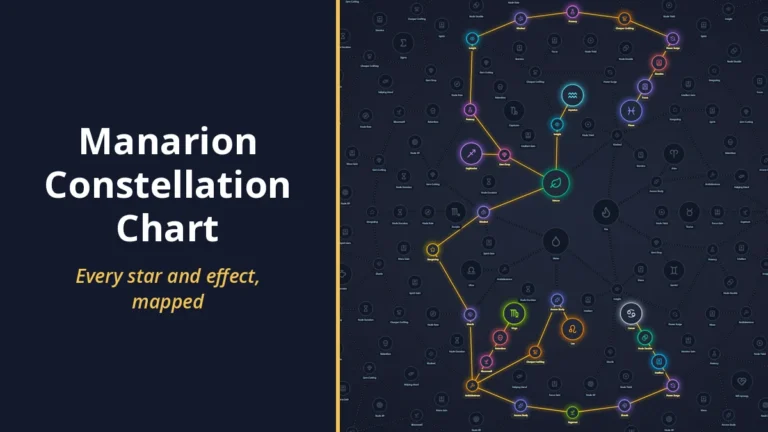
With 261 stars and branching paths, it is easy to waste stars on a long detour to the one you want. Our free Manarion Starchart Planner lets you mark the stars you own, pick the ones you want and see the cheapest unlock order and how many Stars Charted it will take. For the Stars Charted needed for every star and the full list of star effects, see our Manarion Constellation Chart.
Common Beginner Mistakes
- Playing without a guild. Every hour outside a guild is an hour without its experience, shard and action bonuses. Join any active guild on day one.
- Spending Codex without a goal. Decide what you want to speed up first (levels, income, the Mage Tower, pets or Starcharting) and put your Codex there. Resetting later costs Codex.
- Sitting on Elemental Shards. Spend them on your core stats as you earn them. Unspent shards do nothing.
- Skipping events. Elemental Rift gives eggs and Sigil progress, and Rift of Power upgrades your gear for free.
- Selling Codex and shards for quick Mana Dust. They are worth far more invested in your character.
- Using orbs on gear you will replace. Sell them early, or save them for Heirlooms and your first Mythic.
- Fighting the wrong element. Fight in the zone of the element your spells beat, and use a staff that matches your spell’s element.
- Learning every enchanting formula yourself. Send formulas to your guild’s enchanter if it has one, or sell the ones nobody needs.
- Ignoring pets. Buy Egg Drop as soon as you have an Egg. Pets compound, so starting late costs you.
- Not asking questions. Guild chat and the Discord are friendly, and experienced players are usually glad to explain how a system works.
Useful Commands and Community Tools
| Command | What it does |
|---|---|
| /help | Lists every command |
| /profile name | Opens a player’s profile |
| /wire name amount item | Sends items to another player (part of the item name is enough if it is unique) |
| /r | Replies to your last whisper |
| /afk message | Sets an away message for whispers |
| /event | Shows the latest Elemental Rift results and the next spawn time |
| /ignored | Shows your ignore list |
| /transferguild | Hands guild leadership to someone else |
A few settings are worth changing early: switch to clickable tooltips if hovering is awkward (especially on mobile), turn on notifications for events, Rift of Power and pet level-ups, and favorite your important items so bulk disenchant never touches them.
Community tools:
- Manarion Discord: the main community hub for questions, guild recruitment and update news.
- Manarion Helper userscript: a popular browser userscript with interface improvements.
- Stats, Shards, XP, Dust, Quest, Res, Loot and Level tracker: a userscript that tracks your gains per hour.
- Manarion API: public player, guild, leaderboard and market data, for players who like spreadsheets.
- Manarion Dungeon Time Calculator and Starchart Planner: our two free Manarion tools.
Frequently Asked Questions
Is Manarion free to play? Yes. Manarion is free in your browser. The optional QoL subscription costs 5 Crystallized Mana a month, which you can buy with in-game Mana Dust, and it adds convenience rather than power.
How much time does Manarion take each day? Very little. The game runs on the server while you are away, so a few short check-ins a day to refresh actions, claim quests and spend resources are enough for steady progress.
Should I choose battling or gathering? Both are balanced and equally idle. Pick battling if you enjoy tuning damage, and gathering if you want a calmer loop, faster pet leveling and a steady role supplying your guild.
Can I switch between battling and gathering later? Yes, at any time. Your Codex and shard research carries over, but each path uses its own equipment, so you will need a new set of gear for the other path.
Do I really need a guild? Yes. Guild buildings boost experience, shard power, action capacity and mana costs for every member, and the armory lets you borrow gear. Join any active guild on your first day.
What are Heirlooms? Heirlooms are Legendary items converted with an Orb of Legacy. They keep half the item’s level and power but have no level requirement, so new players can wear them from level 1, borrowed from a guild armory or crafted themselves.
What are Gathering Nodes? Gathering Nodes are resource spots that any character can find, battlers included, with a 1 in 2,400 base chance per tick. A node lasts 100 ticks and yields Quartz, Ink or Resin, which pay for Starcharting research.
Should I play Ironman mode as a beginner? It is better to start on a normal character. Ironman has no player trading and only solo guilds, so it is easier once you know the game. You can add an Ironman character later from your account settings.
What is Starcharting? Starcharting is a constellation skill tree added in October 2026. You earn Stars Charted over time and spend each new star on an effect next to one you already own, starting from a Fire, Water or Nature origin.
What should I buy first with pet eggs? Buy the Egg Drop pet first. It finds extra eggs from your normal actions, so every pet after it arrives sooner. Then pick the core pets for your path.
Related Guides
- Manarion Dungeon Guide: dungeon modes, Dungeon Point upgrades, skips and guild dungeons in depth.
- Manarion Dungeon Time Calculator: how long a solo guild dungeon takes at your levels.
- Manarion Starchart Planner: the cheapest route to the constellation stars you want.
- Manarion Codex Chart: the cost and bonus of every Codex boost level.
- Manarion Constellation Chart: Stars Charted for every star and every star effect.
- Manarion Pets Chart: all 25 pets with their effect by level, XP costs and what top players run.
Have a tip that belongs in this guide, or did a patch change something here? Tell us in the comments below. We read every one and update the guide when the game changes.