Sudeki – Where Are They Now? A Retrospective

Note: The original interview has been preserved and can be read via the Internet Archive.
The Vision Behind Sudeki
Sudeki represented Climax Studios’ first major foray into the RPG genre and one of Microsoft’s strategic efforts to attract JRPG fans to the Xbox platform. Released on July 20, 2004, in North America, the game aimed to bridge the gap between Western and Japanese RPG sensibilities with its unique hybrid combat system and vibrant visual style.
The game began development in September 2000 after platform shifts from its original Dreamcast conception. With a team of 50-70 people (over half of Climax Solent’s staff at the time), Sudeki was described as the largest project the studio had ever undertaken.
The Hybrid Combat System
What made Sudeki stand out was its innovative “OneTime” system, a blend of real-time action and turn-based tactical depth. As Jason Avent explained in the interview, the system allowed the game to run at reduced speed while players navigated menus to make tactical decisions during combat.
The OneTime system started at 5% normal speed early in the game, gradually increasing to 40% as players progressed. This created what Avent called “Matrix style moments” while maintaining pressure and strategic depth. The four-tiered combat system included basic attacks, chained combos, interactive Skill Attacks, and powerful Spirit Strikes that summoned gods to devastate enemies.
The Four Heroes
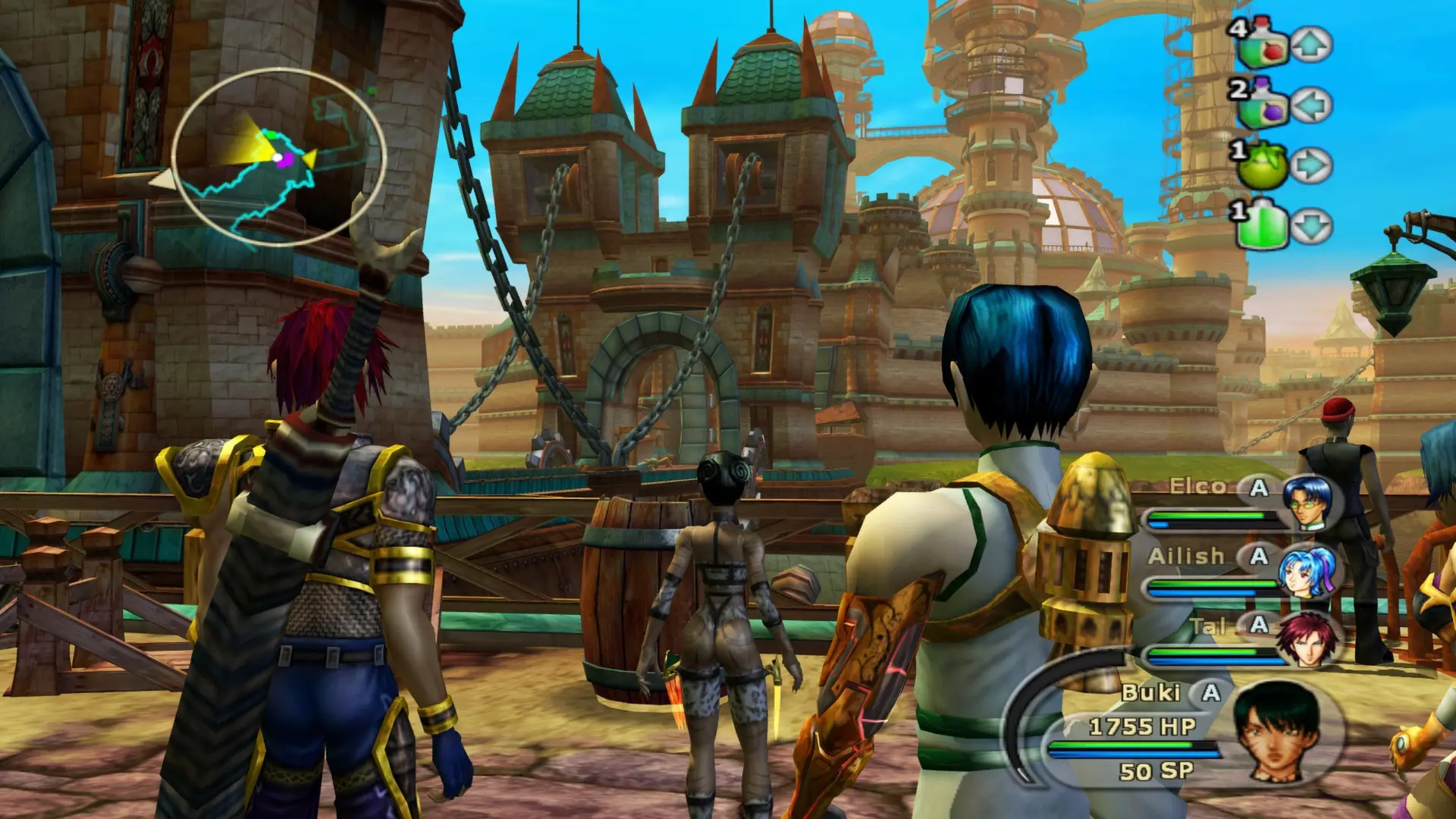
Sudeki’s narrative followed four distinct characters, each with unique abilities and combat styles:
Tal – An Illumina Guard member and the first playable character. Strong enough to push and pull large objects for puzzles, Tal wielded heavy weapons for powerful but slow melee combat. He had romantic feelings for Princess Ailish.
Ailish – Princess of Illumina with magical heritage. Her special ability allowed her to view and dispel illusory objects, revealing hidden pathways and magical elements to the party. She specialized in short-range magical combat.
Elco – A renowned scientist creating machines to win the war for Illumina. His custom jetpack enabled him to cross ravines and reach elevated areas. Elco used rapid-fire guns for effective medium-range combat.
Buki – A half-human, half-cat anthropomorph from Shadani Mo. Lightning fast with deadly claws, Buki could climb sheer surfaces inaccessible to other party members. Her claws made her a devastating close-range fighter.
The squad-based system allowed players to directly control one character while the other three provided support through customizable AI settings. Some enemies could only be defeated using specific characters’ special abilities, creating tactical depth through character switching.
Three Worlds, One Story
Set on the splintered world of Sudeki, divided into twin planets, Illumina (the light world) and Akloria (the dark world), plus a shadow world, the game presented a massive war between light and darkness with a twist: players would need to discover whether they were fighting for the right cause.
Each of the three worlds featured distinct atmospheres, creatures, and histories. The developers emphasized creating a believable fantasy world with wandering creatures, NPC dialogue delivered through full voice acting, and environments that drew players into immersive exploration.
Key Highlights From the Original Interview
The 2003 interview with Jason Avent revealed several fascinating aspects of Sudeki’s development:
On Combat Philosophy: Avent emphasized that Sudeki aimed to deliver “the best of both worlds” by combining arcade-style action with tactical depth. The OneTime system was specifically designed to keep players under pressure while providing thinking time.
On Magic and Spells: The spell system featured interactive Skill Attacks cast using weapons as magical wands, plus ultimate Spirit Strikes that could be carefully linked between characters for devastating combined effects.
On Creating Believable Worlds: Avent identified the challenge of developing a believable world with its own history and communicating it effectively to players. The team used wandering creatures, full voice acting for NPCs, and detailed environmental storytelling to achieve immersion.
On Squad Tactics: With four characters providing four times the tactical options, players could combine abilities for greater effect and tinker with AI settings for optimal support. Characters could provide covering fire, draw enemy attention, or execute berserk attacks while the player controlled another.
The Game’s Release and Reception
Sudeki launched on Xbox in North America on July 20, 2004, followed by European release on August 27, 2004. A PC port developed by Climax Action was released in Europe on March 25, 2005.
Critical and Commercial Performance
The game received mixed but generally positive reviews, with praise for its visual design, innovative combat system, and ambitious scope. However, sales were modest – in September 2004, Sudeki was the tenth-best-selling Xbox title in North America, with over 16,500 units sold in August. In the UK, it reached only #25 in general sales charts during its first month.
In Japan, where Microsoft hoped to leverage the game’s JRPG appeal, Sudeki sold over 6,200 units over its lifetime, making it the 78th best-selling Xbox game in the country. The Japanese release featured notable voice actors including Kenji Nojima, Mai Nakahara, Hikaru Midorikawa, and Yū Asakawa, with cover art by manga artist Yamato Yamamoto.
Technical Achievement
At the time of release, Sudeki was praised for its impressive graphics, particularly on the Xbox hardware. The custom-built engine directly streamed data through the Xbox’s hard drive to minimize loading times. The lighting system featured dedicated effects for different body types, and characters had sophisticated facial animation systems – player characters had 15 facial shapes while NPCs had eight.
The team pushed the Xbox to its limits by utilizing optimization techniques, such as rendering static geometry with pre-established push buffers, to reduce both CPU and GPU workload. The result was a visually striking game that maintained performance even during chaotic four-character battles.
Player Reception
Players generally appreciated Sudeki’s colorful, sometimes vibrant aesthetic combined with mature combat that featured dismemberment and enemy destruction. However, many expressed frustration with the game’s abrupt ending, which left the story feeling incomplete.
One animator from the development team later created a short animated sequence, showing what happened after the final battle, assisted by voice actors, to provide fans with closure on the narrative. This unofficial post-ending content demonstrated the team’s connection to their audience and awareness of the game’s narrative shortcomings.
What Happened After Sudeki?
The Sequel That Wasn’t
Shortly after Sudeki’s release, rumors circulated about “Sudeki 2” based on job listings from Climax. However, this turned out to be a typo. Microsoft, which owned the Sudeki intellectual property, had not requested a sequel nor hired Climax for such a project. The lack of commercial success and Microsoft’s shifting priorities meant Sudeki would remain a standalone title.
Despite positive reviews and a dedicated fan base, Sudeki never received the sequel many fans had hoped for. The combination of modest sales and Microsoft’s ownership of the IP effectively prevented continuation of the franchise.
Sudeki’s Modern Availability
In 2014, Climax Studios re-released Sudeki on PC through Steam (February 24) and GOG.com (April 23). These modern releases featured:
- Native widescreen support
- Resolutions up to 1920×1080
- Improved controller compatibility
- Better performance on modern hardware
- Reduced loading times
The GOG version was temporarily delisted on May 28, 2020, but returned on March 25, 2025. The Steam version continues to receive positive reviews from players discovering the game decades after its original release, with many praising its performance on modern systems.
You can play Sudeki today via Steam, where it maintains a positive rating from players who appreciate its unique blend of action and RPG mechanics.
Where is Climax Studios Today?
Unlike Evillusion (developers of the cancelled Eon of Tears), Climax Studios not only survived but thrived in the decades following the release of Sudeki.
Silent Hill and Beyond (2006-2010)
After Sudeki, Climax Studios became known for its work in the survival horror genre. In 2006, Konami announced that Climax Action (the rebranded studio) was developing Silent Hill: Origins for the PlayStation Portable, following the original Team Silent’s disbandment. The game was released in October 2007 to positive reviews, with a PlayStation 2 version following in 2008.
Climax continued the Silent Hill franchise with Silent Hill: Shattered Memories in 2009 for Nintendo Wii, PlayStation 2, and PlayStation Portable. The game was described as a “re-imagining” of the original Silent Hill, providing a completely new experience rather than a straightforward remake.
Evolution and Acquisition (2010-2021)
Throughout the 2010s, Climax Studios consolidated operations. By February 2008, only the Portsmouth headquarters remained, after other locations were closed. The studio pivoted toward co-development work and technical services, becoming a reliable partner for major publishers.
In April 2021, Keywords Studios acquired Climax Studios for £43 million (£27 million initial payment plus potential deferred payments up to £16 million based on performance). The acquisition integrated Climax into Keywords’ global network of over 70 studios across 26 countries, providing access to expanded resources for AAA projects.
Modern Success (2021-Present)
As of 2025, Climax Studios operates from four locations: Portsmouth (headquarters), London, Edinburgh (opened February 2024), and Liverpool, with approximately 250 employees. The studio specializes in co-development, porting, and technical support for major AAA titles.
Recent Notable Projects:
Returnal PC Port (2023) – Climax led the PC adaptation of Housemarque’s PS5 roguelike, incorporating PC-specific enhancements like customizable graphics, ultrawide support, and DLSS integration for stable performance across varied hardware.
Age of Empires IV (2021) – Contributed to multiplayer features, enhancing netcode for large-scale RTS battles and cross-play functionality.
Horizon Call of the Mountain (2023) – Co-developed the PS5 VR adventure in the Horizon series.
Mafia: Definitive Edition (2020) – Contributed to development and next-gen enhancements for PS5 and Xbox Series X/S.
Wasteland 3 (2020) – Provided additional content and technical assistance for inXile Entertainment’s post-apocalyptic RPG.
The studio collaborates with major developers, including Sony, Microsoft, Ubisoft, and Electronic Arts, drawing on over three decades of expertise in game development. Climax has successfully transitioned from independent original game development to being a respected co-development partner on some of the industry’s biggest titles.
Visit Climax Studios’ official website to see their current projects and career opportunities.
Sudeki’s Legacy
While Sudeki never achieved blockbuster status or spawned a franchise, it represents an important moment in early 2000s gaming history – a Western studio’s ambitious attempt to capture JRPG magic on a console struggling for Japanese market acceptance.
What Sudeki Got Right
Visual Identity – The colorful, anime-influenced aesthetic combined with mature combat themes created a distinctive look that stands out even today.
Combat Innovation – The OneTime system’s blend of real-time action and tactical menu navigation was ahead of its time, foreshadowing hybrid combat systems in later titles.
Character Variety – Four distinct playable characters with unique abilities and combat styles provided gameplay variety that kept exploration and combat fresh.
Technical Achievement – Pushing the Xbox hardware to its limits while maintaining performance demonstrated Climax’s technical expertise.
Where It Fell Short
Pacing Issues – Frequent backtracking and repetitive combat encounters wore down some players before the story’s conclusion.
Abrupt Ending – The game’s rushed conclusion left narrative threads unresolved, disappointing players invested in the story.
Marketing – Limited promotion meant many potential players never discovered the game, contributing to modest sales figures.
Market Timing – As an Xbox exclusive JRPG-style game in 2004, Sudeki competed against the PlayStation 2’s dominance of the Japanese RPG market.
Community and Fan Reception Today
Modern players discovering Sudeki through Steam often praise its unique approach to action-RPG gameplay. The Reddit community at r/JRPG occasionally features discussions about Sudeki, with players recommending it as a “hidden gem” from the original Xbox era.
Common praise includes:
- Ahead-of-its-time combat mechanics
- Vibrant, memorable visual design
- Strong character variety
- Solid performance on modern PCs
The Sudeki Wiki maintains comprehensive information about characters, locations, and game mechanics, demonstrating ongoing community interest two decades after release.
Frequently Asked Questions
Q: Is Sudeki worth playing today?
Yes, especially if you enjoy action-RPGs with hybrid combat systems. The Steam version performs well on modern hardware, and the unique One-Time combat system remains engaging. However, be prepared for some pacing issues and an abrupt ending.
Q: How long does it take to beat Sudeki?
Most players complete Sudeki’s main story in 15-20 hours, with completionist runs taking 25-30 hours.
Q: Why is Sudeki rated M (Mature)?
The game features violent combat, including dismemberment, blood, and mature themes, despite its colorful aesthetic. The contrast between visual style and mature content contributed to the M rating.
Q: Will there ever be a Sudeki 2?
Unlikely. Microsoft owns the Sudeki IP, and the rumored “Sudeki 2” from 2007 was confirmed as a typo. Climax Studios has moved on to co-development work and hasn’t expressed interest in revisiting the franchise.
Q: Can I play Sudeki on modern consoles?
Not currently. Sudeki is available on PC via Steam but hasn’t been ported to modern Xbox or PlayStation consoles. The original Xbox version can still be played on Xbox 360 via backward compatibility.
Q: What happened to Game Director Jason Avent?
Information about Jason Avent’s post-Sudeki career is limited. He moved on from Climax Studios after the game’s release, but specific details about his subsequent work are not widely documented.
Conclusion
Sudeki’s story is one of ambition realized but potential unfulfilled. Climax Studios successfully created an innovative action-RPG that pushed technical boundaries and experimented with hybrid combat mechanics ahead of their time. While the game didn’t achieve commercial success or spawn sequels, it demonstrated the studio’s capability and creativity.
More importantly, Sudeki represents a significant milestone in Climax Studios’ evolution from an independent developer to a respected industry partner. The technical expertise, production management, and creative problem-solving showcased in Sudeki laid the foundation for the studio’s subsequent success with the Silent Hill franchise and its current role as a major co-development studio.
Twenty years after release, Sudeki remains playable and relevant thanks to modern PC ports. Its unique combat system, vibrant world design, and ambitious scope continue to attract new players, who discover a fascinating piece of Xbox history. The game may not have changed the industry, but it left its mark as a bold experiment in blending Eastern and Western RPG philosophies.
For Game Director Jason Avent and the Climax Studios team, Sudeki represented their first major RPG project – an ambitious first step that, despite mixed commercial results, proved the studio could deliver innovative gameplay experiences on a large scale. That reputation has carried Climax through decades of industry evolution, ultimately leading to their current success as a cornerstone of Keywords Studios’ game development network.
Related Content
Interested in more gaming retrospectives and deep-dive RPG content? Check out our other guides:
- Eon of Tears – Where Are They Now? – The story of Evillusion’s ambitious, cancelled biblical RPG
- Complete Manarion Beginner’s Guide – Master this persistent browser-based RPG
- Battling vs Gathering in Manarion – Choose your optimal path
- Complete Manarion Equipment Guide – Optimize your gear progression
Want to share your memories of Sudeki or discuss other underappreciated Xbox RPGs? Join the discussion in the comments below.
Last Updated: November 2025
Do you have memories of playing Sudeki on the original Xbox or information about the development team? We’d love to hear from you. Contact us through our contact page.