

Complete Manarion Dungeon Guide

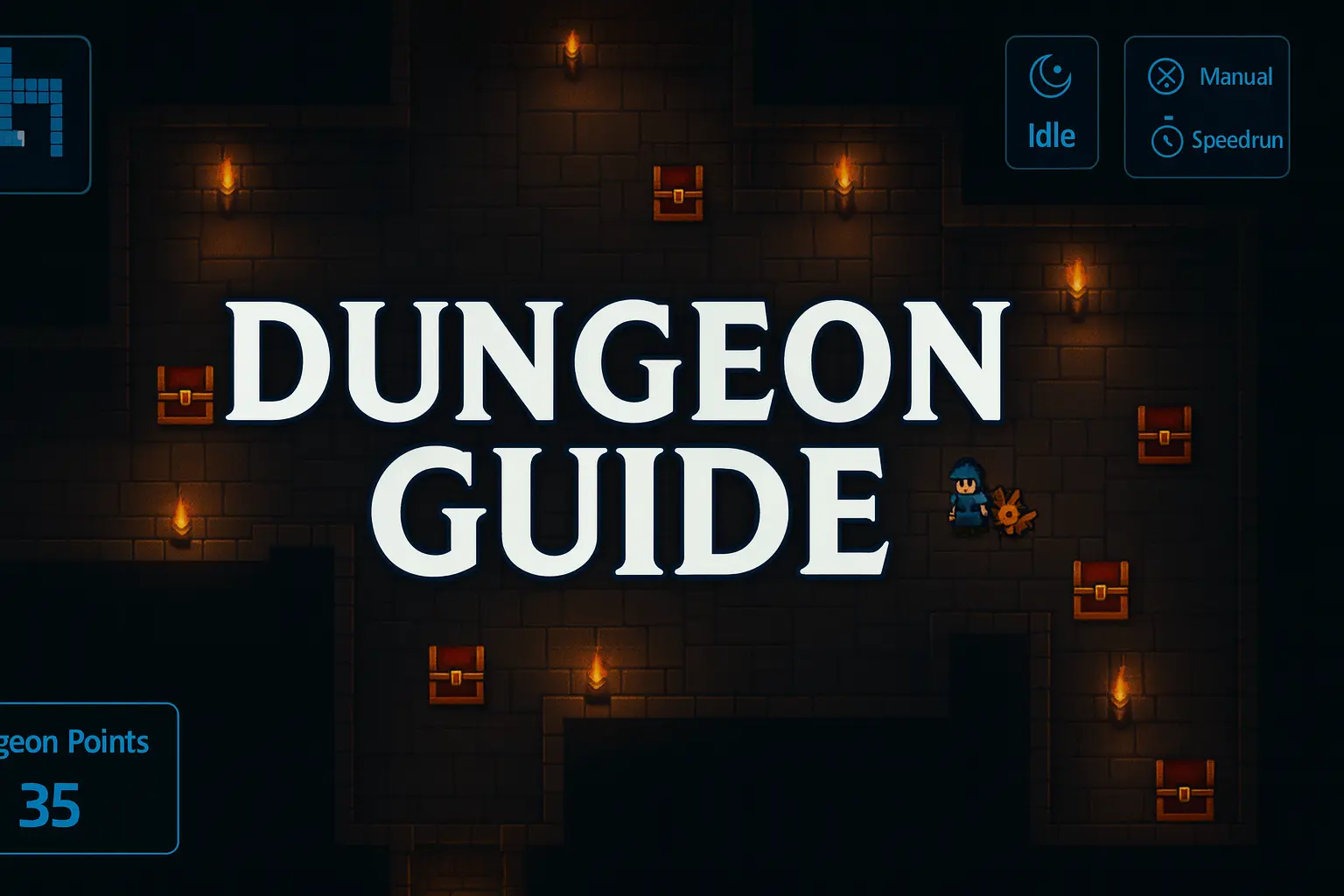
Dungeons are special instanced areas in Manarion that provide valuable rewards, including Elemental Shards, Dungeon Points, and rare loot. Understanding the three dungeon modes and optimizing your approach can significantly accelerate your progression.
This guide covers everything you need to know about dungeons: the three modes (Idle, Manual, Speedrun), dungeon point allocation, skip mechanics, and guild dungeons.
Table of Contents
Understanding Dungeon Basics
What Are Dungeons?
Dungeons are instanced areas where you navigate through rooms, open treasure chests for keys to open blocked paths, and gain random rewards from some of the chests. Unlike regular battling or gathering, dungeons require navigation through a map layout with multiple rooms and objectives(in case of guild/group dungeons).
Completing dungeons awards:
- Elemental Shards – Permanent stat upgrades
- Dungeon Points – Currency for dungeon capability upgrades
- Equipment Drops – Rare loot from treasure chests
Dungeon Sizes
Dungeons come in three sizes, each with different time requirements and treasure chances:
Small Dungeons:
- Quickest to complete
- 20% base treasure chance
- Good for fast dungeon point farming
Medium Dungeons:
- Balanced time and rewards
- 60% base treasure chance
- Most common choice for progression
Large Dungeons:
- Longest completion time
- 1 guaranteed treasure + 20% chance for a second
- Best treasure chances overall
The treasure percentage can be increased through dungeon point upgrades.
Dungeon Availability
The number of available dungeons scales with your highest level. As you progress, more dungeons unlock, providing increasingly valuable rewards. Higher-level dungeons provide better loot and more dungeon points per completion.
The Three Dungeon Modes
Idle Mode (Primary Method)
Idle mode is how most players complete dungeons. Your pet Sniffles automatically navigates dungeons, defeats enemies, gathers from resource nodes, and opens chests while you’re offline or doing other activities.
Idle Mode Characteristics:
- Completely passive – requires little attention
- Slower than manual completion
- Runs even when the browser is closed
- Solid for consistent long-term progression
Idle mode is the standard approach for most players. Set Sniffles to run dungeons automatically and let them complete in the background.
Manual Mode
Manual mode gives you direct control over your character in dungeons. You navigate using WASD or arrow keys, interact with objectives, and open chests yourself.
Manual Mode Characteristics:
- Player-controlled movement and actions
- Faster completion times than idle
- Requires active gameplay
- Can optimize routes for efficiency with portals
Manual mode is optional but provides faster completions if you’re actively playing. Most players use a mix of both modes depending on availability.
Speedrun Mode
Speedrun mode is a practice mode with no rewards. It’s used for testing optimal routes, learning dungeon layouts, and competing on leaderboards.
Speedrun Mode Characteristics:
- No resource cost to enter
- No rewards for completion
- Full control, like manual mode
- Leaderboard competition
Speedrun mode is niche and primarily used by players who enjoy manual dungeon optimization or leaderboard competition.
Dungeon Points System
What Are Dungeon Points?
Dungeon Points are a special currency earned from completing dungeons. They’re spent on permanent upgrades that improve your dungeon capabilities across all future runs.
Every dungeon completion awards dungeon points. The amount scales with dungeon level – higher dungeons provide more points per completion.
Five Dungeon Point Upgrades
1. Idle Progress Speed
- Effect: Makes Sniffles complete idle dungeons faster
- Priority: Very High (for idle players)
- Notes: The most important upgrade if you primarily use idle mode
2. Treasure %
- Effect: Increases treasure chest rewards
- Priority: Medium
- Notes: Push this to level 67 as soon as possible to guarantee 2 treasure rewards
3. Swiftness
- Effect: Reduces manual movement delay
- Priority: High (valuable for manual players)
- Notes: Makes manual navigation smoother and faster
4. Perception
- Effect: Increases view distance in manual mode
- Priority: Low-Medium (manual players only)
- Notes: Helps with route planning and navigation
5. Auto Loot
- Effect: Automatically opens chests
- Priority: Medium (quality of life)
- Notes: Convenience feature, minimal impact on efficiency
You can set up dungeon presets for idle and manual mode, so for idle mode, you can turn down swiftness and perception, and push the idle speed and treasure instead.
Allocation Strategy
For Idle Players (Most Players):
- Idle Progress Speed – Max priority, invest heavily here first
- Treasure % – Second priority, increases reward quality
- Auto Loot – Optional quality of life
- Skip Swiftness and Perception (manual mode only)
For Manual Players:
- Swiftness – Max priority for faster manual runs
- Perception – Second priority for better navigation
- Treasure % – Third priority
- Auto Loot – Optional but decent QoL
- Skip Idle Progress Speed if you never use idle
For Hybrid Players:
- Balance between Idle Progress Speed and Swiftness
- Prioritize whichever mode you use more
- Treasure % benefits both modes equally
Most players should focus on Idle Progress Speed first. Even if you occasionally run manual dungeons, the passive idle progression provides more value over time.
Dungeon Skip System
How Skipping Works
Dungeon skip allows you to instantly complete dungeons and receive rewards without waiting for completion time. This incurs costs but can be valuable for accelerating progress.
Skip Mechanics:
- Costs: Sunpetal (from farming) + Mana Dust
- Effect: Instantly completes the dungeon and awards all rewards
- Reset: Skip costs reset daily
- Scaling: Costs increase based on dungeon level
Example Skip Costs:
Dungeon level 2897:
- 1 skip = 12 Sunpetal + Mana Dust based on dungeon level
- Reward: Shards + 1 Dungeon Point
Higher dungeon levels cost more but also provide proportionally better rewards. Skip costs scale with the dungeon’s difficulty and reward value.
Guild Dungeons
What Are Guild Dungeons?
Guild Dungeons are cooperative dungeons completed by guild members working together. Unlike solo dungeons, guild dungeons have a different structure and reward system.
Guilds unlock new dungeon levels each time the guild levels up. So a level 80 guild can only complete 80 dungeons. If they clear the dungeon before the guild levels up, there will be a demon blocking the exit that you can hit for half damage, which can be good for farming Orbs of Perfection.
Each guild dungeon contains 12 events that must be cleared:
- 2 Fire Knight events
- 2 Water Knight events
- 2 Nature Knight events
- 2 Iron Node events
- 2 Wood Node events
- 2 Fish Node events
Each event has 150,000 HP (based on the guild dungeon level). Guild members contribute damage to each event, and when an event reaches 0 HP, it’s completed, and rewards are distributed to the guild.
Damage Scaling in Guild Dungeons
Your damage to guild dungeon events is calculated differently than regular combat:
Resource Nodes (Iron/Wood/Fish):
- Damage = Your trade skill level
- Example: Woodcutting level 500 = 500 damage per action to Wood Nodes
Elemental Knights (Fire/Water/Nature):
- Damage = Your battle level (if your highest mastery counters the enemy)
- Damage = Half your battle level (if your highest mastery doesn’t counter)
Example:
Player stats: Battle level 30, Water mastery 14.74% (highest), Fire mastery 10.66%, Nature mastery 11.84%
- Fire Knights: 30 damage per action (Water counters Fire)
- Water Knights: 15 damage per action (not countered)
- Nature Knights: 15 damage per action (not countered)
This damage scaling means balanced players (who level both battling and gathering) contribute more effectively to guild dungeons than pure specialists.
Guild Dungeon Rewards
Completing guild dungeon events provides rewards to the entire guild:
Primary Rewards:
- Codex – Scales with dungeon level, goes to the guild vault
- Elemental Shards
- Resources – Fish, Wood, Iron for guild buildings
- Orb of Perfection – Small chance (rare, extremely valuable) as personal loot
Guild dungeons are valuable for guilds because they provide resources needed for building upgrades and Codex for the guild vault, which increases drop rate bonuses for all members.
Ironman Guild Dungeons
Ironman characters can only create solo guilds (you’re the only member). However, you can still access and complete guild dungeons yourself.
Ironman Guild Dungeon Considerations:
- You must clear all 12 events solo
- Damage scales with your own levels
- Requires balanced investment in both battling and all three gathering skills
- Much slower than Standard mode guilds with multiple contributors
- Still provides valuable rewards (Codex, shards, resources for solo guild buildings)
Ironman Strategy:
To efficiently clear guild dungeons as an Ironman, you need:
- Decent battle level (for Elemental Knights)
- Leveled Woodcutting, Fishing, AND Mining (for Resource Nodes)
- Balanced progression across all skills
Use the Dungeon Time Calculator to calculate how long your solo guild dungeon will take based on your current levels. This helps you plan when guild dungeons become efficient, rather than focusing on other progression.
Maximizing Dungeon Efficiency
1. Queue Dungeons Consistently
Never let Sniffles sit idle. Always have dungeons queued, especially overnight. With QoL subscription, you can queue multiple dungeons at once.
2. Invest Dungeon Points Immediately
Don’t hoard dungeon points. Every point invested accelerates future runs. Prioritize Idle Progress Speed for passive players or Swiftness for manual players.
3. Participate in Guild Dungeons
Guild dungeons provide additional rewards on top of solo dungeons. Be active, as there is always gonna be an event available.
4. Balance Dungeon Size Choice
- Early game: Small dungeons for fast point farming
- Mid-game: Medium dungeons for balanced progression
- Late game: Large dungeons for best treasure chances
5. Use Skip Sparingly
Skip costs resources that might be better spent elsewhere. Only skip when you have an abundance of Sunpetal and Mana Dust and want immediate shard income.
6. Upgrade Your Pet
The Dungeon Idle pet increases idle dungeon progress speed. If you primarily use idle mode, this pet compounds with your Idle Progress Speed upgrades.
Dungeon FAQ
Q: Should I do dungeons manually or idle?
A: For most players, idle mode is better for consistent long-term progression. Manual mode is faster if you’re actively playing, but idle runs 24/7 without attention, based on your dungeon queue. Ironman players should consider manual early for full loot.
Q: What should I upgrade first with dungeon points?
A: Idle Progress Speed for idle players, Swiftness for manual players. Idle Progress Speed is the most universally valuable upgrade.
Q: Is dungeon skip worth the cost?
A: Only situationally. If you have abundant resources and want immediate shards, skip can be valuable. Most players should let idle/manual completions handle progression and save resources for other upgrades.
Q: How do guild dungeons work in Ironman?
A: Solo Ironman guilds can still do guild dungeons, but you must clear all 12 events yourself. This requires balanced levels in battling and all three gathering skills. Use the Dungeon Time Calculator to see if guild dungeons are efficient for your level.
Q: Can I queue multiple dungeons at once?
A: Yes, with a QoL subscription, you can queue multiple dungeons. Without QoL, you can only queue one at a time. Always keep dungeons queued for continuous progression.
Q: Do dungeon sizes matter for rewards?
A: Yes. Small dungeons have 20% base treasure chance, Medium have 60%, and Large have 1 guaranteed + 20% chance for a second. Large dungeons provide the best treasure chances but take longer to complete.
Q: Should I do small, medium, or large dungeons?
A: It depends on your goals. Small for fast dungeon point farming, Medium for balanced progression, Large for best treasure chances. Most players settle on Medium or Large once Idle Progress Speed is upgraded.
Q: Why do idle dungeons give half the loot?
A: Idle mode provides reduced loot as a balance for being completely passive. Manual mode requires active play and rewards that effort with full loot. Early Ironman players benefit from manual play when possible.
Dungeon Pet Synergy
The Dungeon Idle pet increases idle dungeon progress speed. This synergizes with Idle Progress Speed dungeon point upgrades:
Compounding Effect:
- Idle Progress Speed upgrade: +X% faster
- Dungeon Idle pet: +Y% faster
- Combined: Significantly faster idle completions
If you’re primarily an idle dungeon player, invest in both the Dungeon Idle pet and Idle Progress Speed upgrades for maximum efficiency.
Conclusion
Dungeons are a core progression system in Manarion, providing Elemental Shards, Dungeon Points, and valuable loot. Understanding the three modes and optimizing your approach ensures steady long-term advancement.
Key Takeaways:
- Use idle mode for consistent progression – Sniffles runs 24/7 without attention
- Invest in Idle Progress Speed first – Most important dungeon point upgrade for passive players
- Manual mode for active play – Faster completions and full loot (especially important for early Ironman)
- Skip sparingly – Resource cost is high, only use when abundant
- Participate in guild dungeons – Extra rewards for minimal effort
- Queue continuously – Never let Sniffles sit idle
- Balance your levels (Ironman) – Guild dungeons require battling + all three gathering skills
Dungeons complement your main progression path (battling or gathering) by providing additional shards and rewards. Set Sniffles to work, invest your dungeon points wisely, and watch your power scale over time.
For more Manarion guides covering other systems, see:
- Complete Manarion Beginner’s Guide
- Battling vs Gathering Guide
- Complete Equipment Guide
- Complete Pet System Guide
- Guild System Complete Guide
- Complete Ironman Mode Guide
- Events Guide (coming soon)
Last Updated: November 18, 2025 – Manarion is actively developed, so some details are subject to change. Check the Manarion Discord for the latest information.


